Why liquidity is the only moat that compounds
Every moat proposed for an onchain protocol has been tested and most of them have failed. Code is public and forkable, usually within days. Teams are hireable. Brand decays at the speed of the next incident. Token incentives buy attention for exactly as long as they are paid for, and the mercenary capital they attract leaves faster than it arrived.
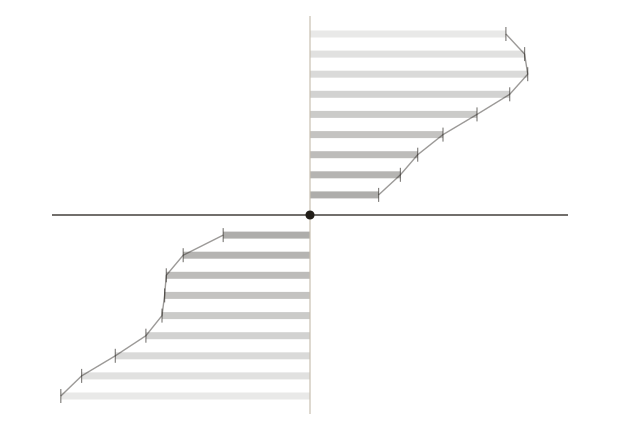
Liquidity behaves differently, and the reason is structural rather than cultural. Depth produces better execution, better execution attracts flow, flow produces fees, fees attract the market makers who supply depth. Each turn of that loop makes the next turn cheaper. A fork inherits the code and none of the loop, which is why forks of liquid venues so reliably fail to take the liquidity with them.
This has an uncomfortable implication for anyone building infrastructure. If liquidity is the compounding advantage, then infrastructure that does not touch liquidity is competing on properties that can be copied. We have taken this seriously in the lab’s own roadmap: the primitives we invest most heavily in are the ones that sit in the path of flow rather than adjacent to it.
The caveat worth stating is that liquidity compounds in both directions. The same loop that makes depth self-reinforcing makes its loss self-reinforcing too. Venues do not usually bleed liquidity gradually; they hold, and then they do not. Anyone treating liquidity as a moat should be equally clear that it is a moat which can empty overnight if the mechanism underneath it stops being trusted.
Which is, in the end, an argument for boring engineering. The compounding advantage is downstream of the thing nobody notices when it works.